
Podcast: Play in new window | Download (9.7MB)
Subscribe: Apple Podcasts | TuneIn | RSS | More
This CX Mini Masterclass provides step by step instructions for how to develop a service blueprint, a key tool for any CX team embarking on service design. Show host and customer experience expert, Julia Ahlfeldt, explains what a service blueprint is, how you build one and – most importantly – how to use it. If you’re looking for a practical explanation of how to build and use a service blueprint, then this episode is for you.
The next step in service design
Episode 58 looked at service design, which is the activity of planning and organizing people, infrastructure, communication and material components of a service in order to improve its quality and the interaction between the service provider and its customers. And with most brands out there today delivering a hybrid of both goods and services, it’s important for teams to carefully orchestrate how they deliver experiences. If not, they’ll risk things completely falling apart.
Service blueprinting is an important step for any team looking to implement service design. The actions needed for an organization to deliver a service are often complex and need to be documented before plans can be made. That’s what service blueprinting is all about.
Creating the service blueprint
Service blueprinting is essentially a visual documentation of service design. To build a service blueprint you need to start with the customer journey. And in this case, it should be a very simplified version of the journey, highlighting the aspects of the journey where the organization in question plays a major role. Remember that when we map entire journeys, we need to consider experiences outside of the realm of just one brand’s interactions with the customer – but in this case we’re looking inward, so it’s OK.
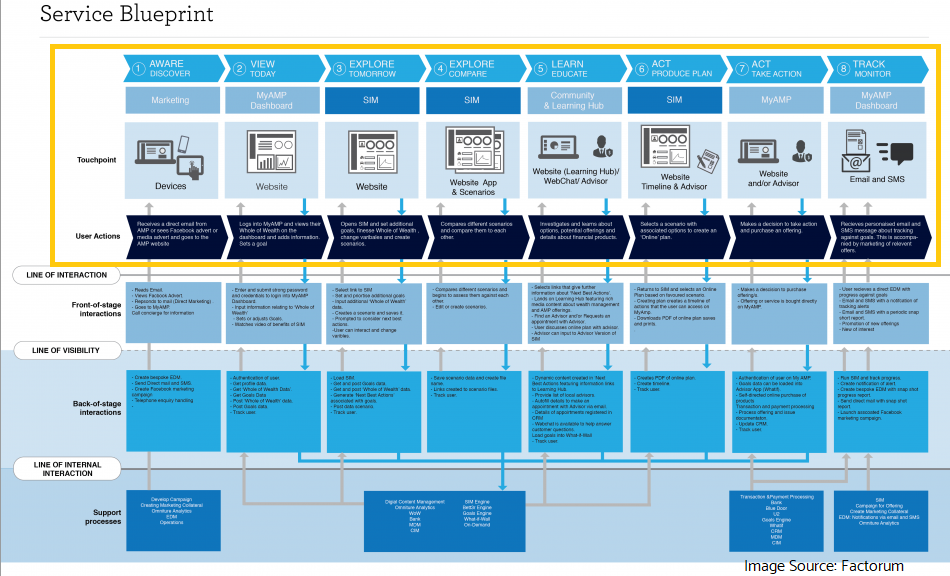
A service blueprint often also includes a space for physical evidence, though this isn’t required.
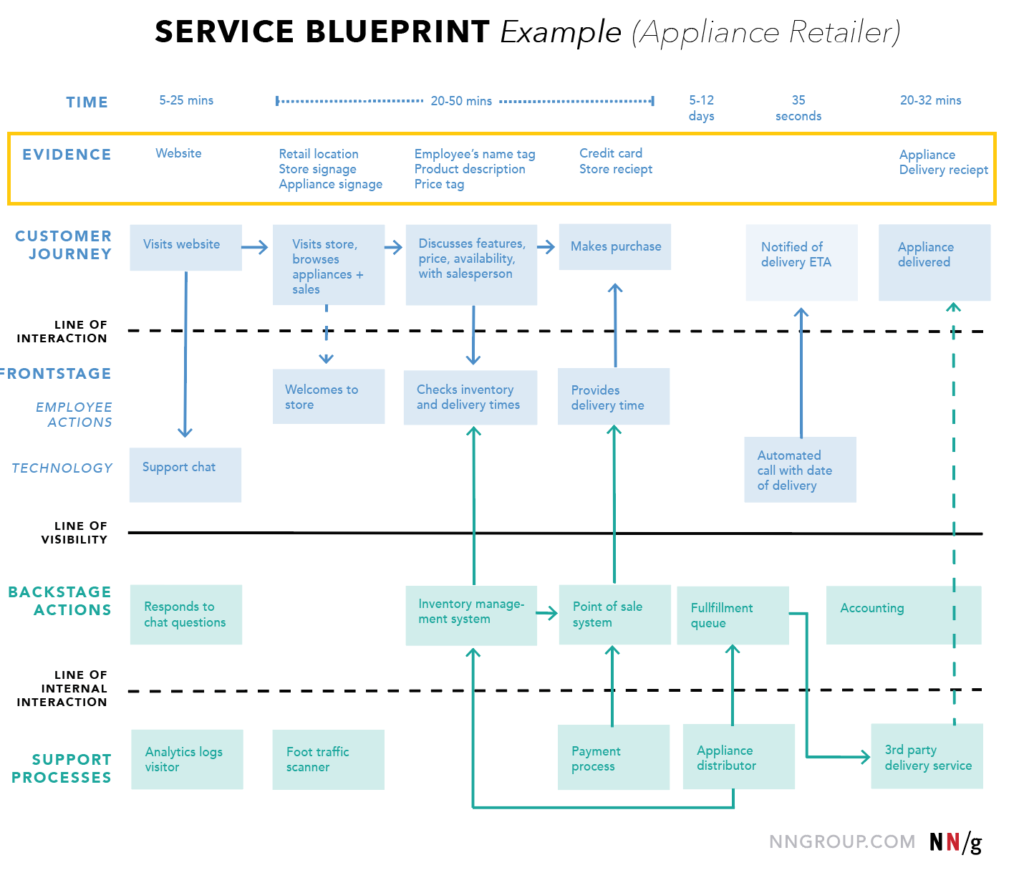
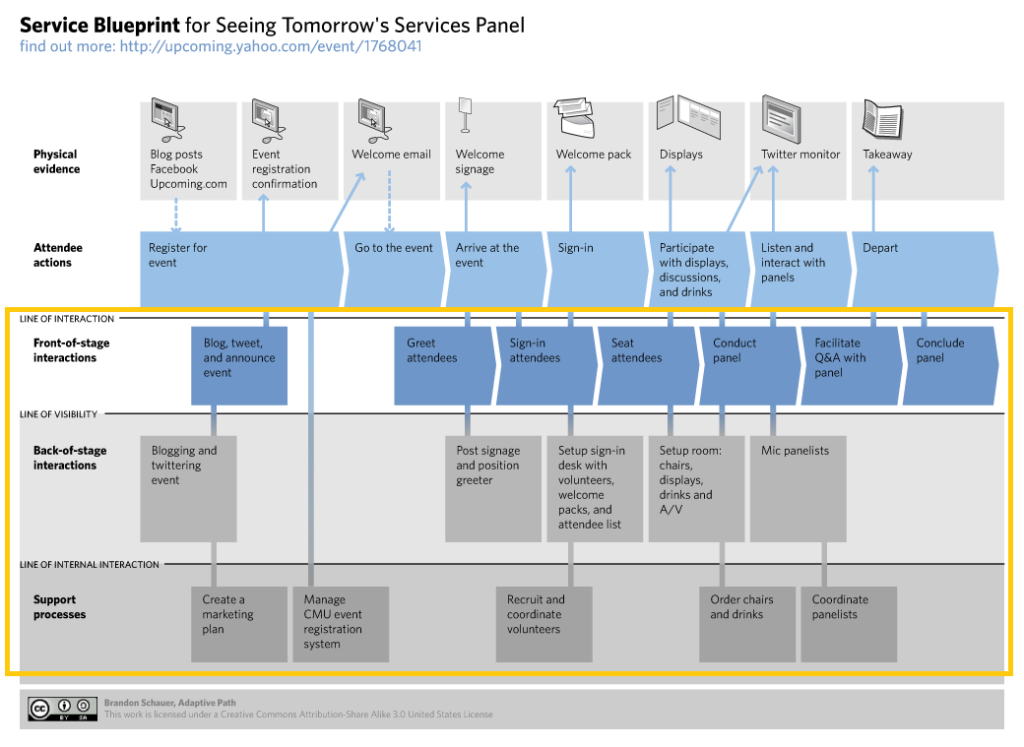
The next step is to capture the layers of service functions, starting with what the customer sees. In the world of service blueprinting, these are sometimes called front stage interactions. The next layer down captures the backstage interactions or the operational support that the customer doesn’t see, and finally every service blueprint should include a final layer of strategic support functions.
Leveraging the blueprint as a CX tool
Like journey maps, service blueprints are highly dynamic CX tools that bridge the conceptual divide between the journey and a business’s operating model.
Service design is about helping organizations coordinate their activities to deliver experiences. Anyone who has worked in a large corporation will know that the silo mentality is real! Service blueprints can help CX leaders unite teams around the customer journey in a number of ways:
- Demonstrating how teams from different organizations need to collaborate to deliver the journey.
- Clarifying team level contributions and determining KPIs that relate back to the journey.
- Conducting root cause analysis on where specific experiences are breaking down so that teams can work on solutions.
- Defining how teams will deliver new experiences, either by building future state service blueprints or by demonstrating how current actions would need to change to deliver a re-imagined experience.
Episode transcript
Read transcript
Welcome to Decoding the Customer, a podcast about customer experience and how to realize customer-centric change in today’s dynamic business world. I’m Julia Ahlfeldt, certified customer experience professional, business advisor, and host of this program. Thanks so much for tuning in. If you’re new to the show, welcome.
If you’re a returning listener, thanks, and it’s great to have you back. This episode is part of my CX Mini Masterclass series here on Decoding the Customer. These weekly episodes are published each Thursday and designed to be punchy, bite-size overviews of key customer experience concepts and ideas for how you can help your organization thrive through customer centricity. Whether you’re new to the field of customer experience, are preparing for the CCXP exam, or are a seasoned professional looking to brush up on a few basics, this series will help you improve your knowledge, skills, and performance to stand out as a CX professional.
And if you’re keen to do some more intensive online training in the field of customer experience, stay tuned at the end of this episode for an exclusive listener discount code from CX University. This is episode 59, the fourth episode in the month of October, a month I’ve dedicated to exploring topics that are a buzz in the CX professional community. I’m doing this so that we can unpack how these topics relate back to the work that many of us are doing in the field of customer experience. Today, I’m covering service blueprinting.
Last week’s episode, number 58, explained the concept of service design. And this week, I’m covering a practical tool for documenting service design. I’ll explain what a service blueprint is, how to build one, and most importantly, how to use it. I’ve seen a lot of journey maps die sad and lonely deaths on CX managers’ laptops, and we don’t want that to happen to your service blueprint.
So it’s important to have a plan. If you’re looking for a practical explanation of how to build and use a service blueprint, then this episode is for you. As always, if you’re out and about while listening to this, and here’s something that you’d like to remember later, don’t worry about writing it down. You can find an overview of the key concepts that we’ve covered today in the show notes for this episode, which are on my website, juliaahlfeldt.com or decodingthecustomer.com.
As mentioned, last week’s episode looked at service design. Which is the activity of planning and organizing people, infrastructure, communication, and material components of a service in order to improve its quality and the interaction between the service provider and its customers. And with most brands out there today delivering a hybrid of both goods and services, it’s important for teams to carefully orchestrate how they deliver experiences. Otherwise, they’ll risk things completely falling apart.
When I help teams map customer journeys, I find that a lot of people will gravitate quickly towards an inward looking view on things. As a journey mapping facilitator, I often have to fight the tide on this one and help teams do what they aren’t always comfortable doing, looking at the world through the customer’s eyes. I do, however, tell teams not to worry because there is a time and a place for looking inward and understanding how the business’ operating model supports the journey. And service blueprinting does just that.
It’s where we get to turn our perspectives inward to the people, processes, and technology that make experiences happen. Service blueprinting is essentially a visual documentation of service design. I’ll include a downloadable template in the show notes for this episode. And you can find a lot of great examples through a simple Google Image search.
But a service blueprint looks a bit like a simplified journey map with little strings of support functions trailing down from each phase of the journey. To me, it almost resembles a series of lily pads with the journeys at the top as the visible part of the lily pad, and then the organization support processes as a submerged network of routes. Again, if I lost you on that metaphor and you’re more confused now than you were before, just hop online and find a quick example to anchor the concept. To build a service blueprint, you need to start with the customer journey.
And in this case, it should be a very simplified version of the journey, highlighting the aspects of the customer experience, where your organization plays a major role in the customer experience. Remember that when we map an entire journey, we need to always consider experiences that happen outside of the realm of just one brand’s interactions with the customer. But in this case, we’re looking inward, so it’s okay to focus on where the brand plays the biggest role. For each phase of the journey, we need to capture the details about how the organization supports delivery of the experience.
Often, this starts with something called physical evidence, which could be a product or a tangible output from a touch point, like a text message or an email or a flyer. Once we’ve documented the physical evidence, we need to capture the service functions that the customer sees. In the world of service blueprinting, these are sometimes called front-stage interactions. The next layer down captures the backstage interactions, or the operational support functions that the customer doesn’t see.
And then finally, we document the last layer, or the roots of the lily pad, or the strategic support functions are. Now, I know that all of this is probably sounding pretty abstract. So let’s take a tangible example. Let’s say that we work for a sit-down pizza restaurant, and we’re doing service blueprinting for the in-restaurant dining experience.
For the sake of this example, let’s hone in on the food ordering phase of the journey, which remember would be one of several phases running along the top of our service blueprint. In this case, the physical evidence would be the menu. That would go right next to the phase of the journey. Next, we look at the front stage functions or what the customer would see, which in this case would be the waiter providing the menu, explaining the specials, answering questions, and then maybe returning to take your order.
Behind the scenes, you’ve got the daily special planning, kitchen preparation, menu printing, and the process of communication between the waitstaff and the kitchen to place the orders. That’s your backstage interactions. But below that, there’s even another layer of support functions. The strategy for the menu has to be defined so that it appeals to the clientele in the neighborhood.
Maybe there’s an electronic system that waitstaff use for capturing orders and billing. And then of course, someone has to hire and train the waitstaff to be able to do their job. There are undoubtedly many more support functions that we could document, but you get the point. We start with the journey and then work our way through the functions that are needed to deliver the experience.
Documenting those that are visible to the customer first, followed by the operational support functions that are not visible to the customer, and then finally, those strategic support functions that happen way, way behind the scenes. This example included three layers of service functions, but there’s really no reason that you couldn’t add more if needed. I’ve seen service blueprints that have a support layer dedicated completely to technology platforms. Build a blueprint that works for you and your team, but remember that it has to start with the journey, and at a minimum, it should include three layers.
In terms of building the service blueprint, I suggest creating a bare bones template, ideally on a conference room wall, and then documenting your simplified journey at the top with the physical evidence. Then, once you’ve got that in place, engage with various teams within your organization to add the appropriate information. Start by inviting the customer-facing teams to help you establish the key points for your front stage layer. Then, invite the operational support teams to help with the next layer.
And finally, for the support functions, reach out to teams like IT, HR, and marketing, maybe even finance and some others. Teams that are the furthest removed from the customer are likely to contribute to the journey at the strategic support capacity. Remember, those are the roots of the lily pad, furthest removed from the journey. Engaging with these teams may help them understand their role in the customer journey, even if there are many steps removed from the actual customer.
Once you’ve included the process of engaging with these teams, you’ll probably have the makings of a service blueprint. Like journey maps, service blueprints will change as experiences and businesses evolve. Think of your service blueprint as a living document. But what are service blueprints good for anyway?
As mentioned at the start of this episode, service design is about helping organizations coordinate their activities to deliver experiences. Anyone who’s worked in a large corporation will know that the silo mentality is real. Service blueprints can be used to demonstrate how teams from different parts of the organization need to collaborate to deliver the journey. Service blueprints can be used to determine team-level KPIs that relate back to the journey so you can effectively rally people around a common goal and drive accountability.
They can also be used for root cause analysis on where specific experiences are breaking down so that teams can work on solutions. Finally, once you’ve made a service blueprint for an existing journey, you can also use it as a roadmap for defining how teams will deliver new experiences, either by building the future state service blueprint or by demonstrating how current actions would need to change in order to deliver a reimagined experience. Service blueprints are incredibly dynamic tools that bridge the conceptual divide between the journey and the business’ operating model. If you’re looking for help with service blueprinting in your organization, please get in touch.
I’d be happy to explore how I could help. You can reach me via email, tweet, or LinkedIn message. My handle is at Julia Ahlfeldt and my full contact details are also listed on my website, juliaahlfeldt.com or decodingthecustomer.com. So that’s it for this week.
Thanks for listening. If you’re enjoying the show, please share the program with others who might be interested or head on over to iTunes and rate the podcast. This helps others find the show. I’ll be back next Thursday with another Mini Masterclass.
Be sure to tune in then or subscribe for updates when new episodes go live. Are you keen to do some more intensive online training in the field of customer experience? If so, I’d encourage you to check out CX University. They offer a broad array of e-learning options that you can access anywhere and anytime.
Their offering includes practice tests for the CCXP exam, and their Customer Experience Professionals Association accredited resource and training provider, meaning that their materials have been reviewed and vetted by the association for alignment to the six core competencies that are in the exam. And what’s better is that all this is available on a flexible monthly subscription plan, meaning that you don’t have to fork over hundreds of dollars to get started. As of the time of publishing this episode, plans including CX courses and practice exam questions start at just $75 per month. And listeners to the podcast can use the discount code PODCAST10 to get 10% off the first month subscription and help support the show.
See you next Thursday.
Want to keep learning about CX?
If you’d like to checkout more of these CX Mini Masterclasses or listen to my longer format CX expert interviews, check out the full listing of episodes for this CX podcast.
And if you are looking to super-charge your CX skills and continue learning, be sure to check out CX University. They have a great array of CXPA accredited training resources available on a flexible monthly subscription plan. Use the code PODCAST10 to get 10% off your first month’s subscription and support this podcast.
Decoding the Customer is a series of customer experience podcasts created and produced by Julia Ahlfeldt, CCXP. Julia is a customer experience strategist, speaker and business advisor. She is a Certified Customer Experience Professional and one of the top experts in customer experience management. To find out more about how Julia can help your business achieve its CX goals, check out her customer experience advisory consulting services (including B2B CX strategy) or get in touch via email.