
Podcast: Play in new window | Download (8.2MB)
Subscribe: TuneIn | RSS | More
This CX Mini Masterclass explores employee reward and recognition programs as an important driver of team culture. Show host and customer experience expert, Julia Ahlfeldt, explains the different types of recognition programs and how these can help rally teams around customer excellence. If you’ve been looking for some ideas about how to leverage rewards and recognition to encourage customer-centric attitudes and behavior in your organization, then this episode is for you.
An important piece of the CX culture puzzle
Episode 66 explored the foundations of HR strategy and how this in turn influences customer-centric culture. Reward and recognition programs are one of these foundations. Over time, how behaviors are recognized and celebrated will influence culture. Celebrated actions become the model behavior and what people aspire to. And over time, these behaviors and norms take hold and turn into what people expect from each other. Obviously, the foundations of culture are multifaceted, and based on more than just reward and recognition programs, but these are an important component (be sure to check out episode 66 for more about the key components of HR strategy).
Different types of recognition programs
Reward and recognition programs come in all shapes and sizes. These programs are defined by 2 key features: public vs. private recognition and peer-to-peer vs. senior recognition.
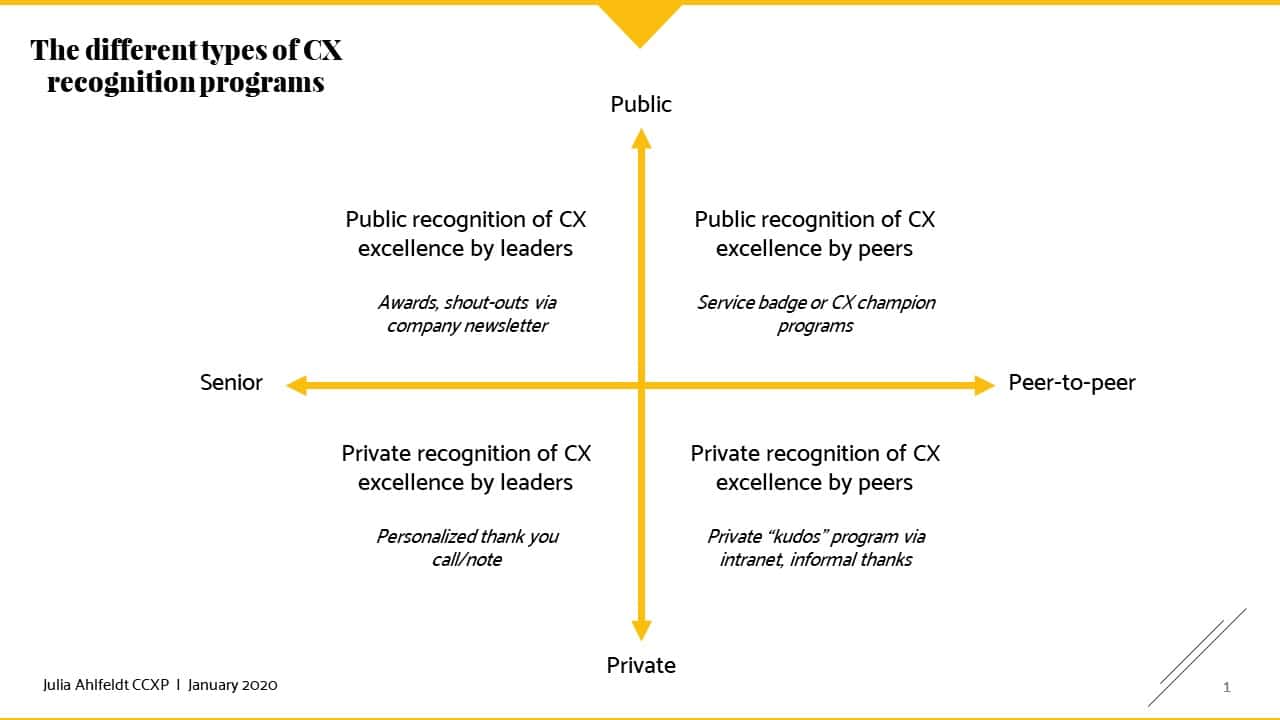
Each organization is unique, so there isn’t a one-size-fits-all solution for recognition programs. It’s probably a good idea to have a variety of different types of recognition structures, but it’s not necessary to have a program for each of these categories. As always, it’s important to think about the end user. When collaborating with HR teams to plan recognition structures, think about how teams interact. What interests the group of employees in question? A program that resonates with frontline team members might differ from what’s needed to impact the behavior of senior managers.
The role of rewards in fostering customer excellence
Rewards can be linked to any of these recognition programs. For example, a senior leader could give a gift card or some company swag to an employee they’re recognizing for customer excellence. Company award programs often include a prize for the winners. Team leaders could also have a discretionary budget to give customized rewards to their team.
It’s also popular to structure peer-to-peer “badge”-type programs with rewards attached. My advice on this is to take the approach of surprise and delight rather than gamification. Give people the latitude to recognize the desired attitudes and behaviors with appropriate rewards, but be wary of anything that encourages team members to chase the prize rather than live the mantra.
If you’re wondering where incentives like bonuses fit into things, don’t worry, this hasn’t been overlooked. Incentives linked to CX KPIs are important, but that’s a big topic, possibly for a future CX Mini Masterclass. *Watch this space*
Transcript
Prefer to read? Here’s the transcript.
Click to expand full transcript
Welcome to Decoding the Customer, a podcast about customer experience and how to realize customer-centric change in today’s dynamic business world. I’m Julia Ahlfeldt, certified customer experience professional, business advisor, and host of this program. Thanks so much for tuning in. If you’re new to the show, welcome.
If you’re a returning listener, thanks, and it’s great to have you back. This episode is part of my CX Mini Masterclass series here on Decoding the Customer. These weekly episodes are published each Thursday and designed to be punchy, bite-size overviews of key customer experience concepts and ideas for how you can help your organization thrive through customer centricity. Whether you’re new to the field of customer experience, are preparing for the CCXP exam, or are a seasoned professional looking to brush up on a few basics, this series will help you improve your knowledge, skills, and performance to stand out as a CX professional.
This is episode 68. The fourth episode of January. 2020 has been slated as the year that customer experience will overtake price and product as the key competitive differentiator. So here we are.
In month one of a new decade, and CX professionals need to be ready to face the challenges of helping businesses become more customer centric. Last week’s Mini Masterclass provided practical tips for internal and external marketing of customer experience. And the week before that, we took a deep dive into the foundations of CX culture and the importance of aligning CX and HR strategies. Today, I’m sticking with the topic of organizational alignment and culture, exploring reward and recognition strategies.
If we want team members to stay rallied around the customer mandate, we need to reinforce the right behaviors. As discussed in episode 66, reward and recognition programs are an important building block for culture. So if CX professionals want to see an authentic customer-centric culture within their organization, they have a vested interest in getting the right rewards and recognition programs going. So if you’ve been looking for clarity on how to structure rewards and recognition to support your organization’s customer experience ambitions, then this episode is for you.
As always, if you’re out and about while listening to this and hear something that you’d like to remember later, don’t worry about writing it down. You can find an overview of the key concepts we’ve covered today in the show notes for this episode, which are on my website, juliaahlfeldt.com, or decodingthecustomer.com. In episode 66, we explored the foundations of customer-centric culture. Reward and recognition programs are one of those foundations.
Over time, how behaviors are recognized and celebrated will influence culture. Celebrated actions become the model behavior and what people aspire to. Gradually, these behaviors and norms take hold and turn into what people expect from each other. Obviously, the foundations of culture are multifaceted and based on much more than just reward and recognition programs.
That said, these programs are an important component and what we’re going to focus on today. Reward and recognition programs come in all shapes and sizes. I like to think of these programs as having two determining features. The first is public versus private recognition.
The next is peer to peer versus senior recognition. If you were to plot these on two axes, you’d end up with four types of recognition. Senior recognition that is public, senior recognition that is private, and peer to peer recognition that is both public and private. Don’t worry, if you’re having a hard time visualizing this, I’ll post an image of the quadrant and the show notes for this episode.
So let’s go through these one by one, starting with senior recognition that is public. An example of this would be an executive giving a shout out to a team member in a public forum like a company newsletter or a team call. Company awards would be another great example of this. These are examples for leaders to highlight attitudes and behaviors that support the organization’s objectives.
If you’re looking to apply something like this in your organization, think about opportunities for leaders to identify and elevate examples of customer centricity, and then ways to publicly shine the light on these cases. Senior recognition as private can be just as powerful. A personalized note or a quick call thanking a team member for going above and beyond can make an incredible impact on morale. It also demonstrates leadership connection to shared values and that all contributions to customer experience make a difference.
Back in episode six of the podcast, I interviewed Clint Payne and Lindy Way Chowka from MultiChoice. They shared insights from their hashtag 99 problems campaign in which team members from across their organization volunteered to tackle the top 99 problems with the customer journey. Upon solving these problems, the resolvers, as they were called, received a handwritten thank you letter from the CEO. When I interviewed Lindy Way, she still had hers at her desk.
Senior recognition can also be as simple as a manager thanking an employee for something they did. It doesn’t have to be super fancy. This recognition isn’t about having your name and shining lights on a billboard. It’s about knowing that you’ve made a difference and that the leadership team really cares.
Leaders play a special role in rewards and recognition, but they’re not the only ones who can and should recognize and celebrate the right behaviors. So let’s move on to peer-to-peer recognition. As with senior-leader recognition, that which comes from peers can be either public or private. Public recognition is about providing kudos and recognizing others publicly, just what it sounds like.
Over the years, I’ve seen lots of Service Badge and Customer Experience Champion programs. Sometimes these are managed through an intranet where colleagues can nominate others. I also recently heard an example of an innovative program at an accounting firm that had established a sort of pay-it-forward recognition structure, enabling frontline teams or those who are client-facing to publicly recognize and support the teams that help them deliver great experience. This program referred to the behind-the-scenes teams as the unsung heroes.
And what I love about this is that it actively engaged team members who might have otherwise felt removed from the customer or been totally unaware of how their contribution to the customer journey made such a profound impact. Finally, we have private peer-to-peer recognition. This could take the form of a private badge or kudos program, or it could be as simple as an informal thank you from a colleague. Depending on the context of the company and the team, a private recognition program might be better received.
It’s easy to imagine a public badge-based program really taking off at a customer service center, for example. But it might not be the best approach for a team of, say, middle management engineers, or perhaps it would be. When structuring these programs, think about your audience. How do they interact?
What interests them? What are the team dynamics? My personal philosophy is that it’s important to have a mix of different types of recognition and rewards programs. I’m not going to say that each organization out there needs to have all four of these rewards and recognition programs, but different types of recognition will resonate with different audiences.
So figure out what’s appropriate for your context. If you can link these programs to career development and people’s professional profiles, all the better. Who wouldn’t want an endorsement from their CEO on their personnel file or their LinkedIn profile? We’ve spoken quite a bit about recognition, but what about rewards?
That’s the other half of this discussion. Well, rewards can be linked to any of these recognition programs. For example, a senior leader could give a gift card or some company swag to an employee they’re recognizing. Those company award programs often come with some sort of prize attached to them.
Team leaders could also have a discretionary budget and give customized rewards to their team based on individual actions throughout the course of the year. I’ve also seen plenty of these badge programs with rewards attached. My advice on this is to take the approach of surprise and delight rather than gamification. Give people the latitude to appropriately reward the right behaviors, but be wary of anything that encourages team members to chase the prize rather than live the mantra.
You’ll notice that I’ve not included incentives in this discussion. Incentives do play an important role in influencing behavior and culture. Back in episode 66, I spoke about the importance of establishing CX KPIs for all team members, and where appropriate, linking these to financial incentives like bonuses. I don’t want to downplay the importance of financial incentives, but it’s a big topic, and probably one for a CX Mini Masterclass all on its own.
If you’re looking for help rallying teams around customer experience or embedding a culture of customer centricity, please get in touch. I’d be happy to explore how I can help. You can reach me via email, tweet, or LinkedIn message. My handle is at Julia Ahlfeldt, and my full contact details are also listed on my website, juliaahlfeldt.com or decodingthecustomer.com.
I hope that you’re enjoying the show. Please share with others who might be interested, or head on over to iTunes and rate the podcast. I’ll be back next week with another CX Mini Masterclass. I’ll see you then.
Want to keep learning about CX?
If you’d like to checkout more of these CX Mini Masterclasses or listen to my longer format CX expert interviews, check out the full listing of episodes for this CX podcast.
Decoding the Customer is a series of customer experience podcasts created and produced by Julia Ahlfeldt, CCXP. Julia is a customer experience strategist, speaker and business advisor. She is a Certified Customer Experience Professional and one of the top experts in customer experience management. To find out more about how Julia can help your business achieve its CX goals, check out her customer experience advisory consulting services (including CX culture change) or get in touch via email.
